fbpx
Play video

Watch your fingers

The Wire Loop allows children to explore the fascinating world of electricity

The Wire Loop is an experience that challenges young inventors to test their hand-eye coordination by guiding a metal loop along a serpentine wire without touching it. The loop and the wire are part of a circuit, and whenever they make contact, a light turns on and a buzzer sounds.

This experience allows children to learn important  scientific concepts, that have been explored by many pioneers of science, in a practical and enjoyable context, encouraging them to explore the world around them with an inventive mindset. This reflects the mission of inspiring future inventors and innovators to think outside the box and apply their knowledge in innovative ways.


About Inspiring Inventors

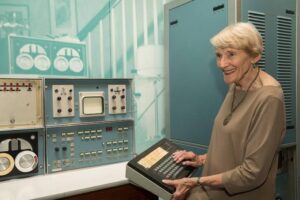
Mary Allen Wilkes

Mary Allen Wilkes

1937-

Is a lawyer, former computer programmer and logic designer, known for her work with the LINC computer, now recognized by many as the world’s first “personal computer”! Wilkes’s contributions to the LINC development included simulating the operation of the LINC during its design phase on the TX-2, designing the console for the prototype LINC and writing the operator’s manual for the final console design. She dealt with circuits, logical precision, where, much like in the Wire Loop, hand-eye coordination was key!

Ask Mary Allen Wilkes

The IA version of Mary Allen Wilkes answer your questions

This dialogue box uses artificial intelligence and is configured to respond exclusively to questions related to the project, its concepts and associated fields, as well as queries and curiosities about the history of each inventor. Questions outside this scope may not be answered. Always use under adult supervision.

Thank you for your understanding.


Concepts Covered

Electricity and circuits

  • Electricity: Is a form of energy that comes from the movement of very small particles called electrons, which are part of atoms. When these electrons move from one place to another, they create what we call an electric current.


  • Circuits: To get the electrons to the other side, we create circuits with materials called “electrical conductors” – in our experiments, we use copper wires. In return, electrons repay the favor when they pass through electronic components we place in the circuit. When they passthrough an LED, the electrons generate light energy; when they pass through a buzzer, they
    generate sound energy, and when they pass through a motor, they generate mechanical energy.

Hand-eye coordination

  • Hand-eye coordination: Is the ability to perform tasks that involve vision and hands. It’s an essential skill for humans because many tasks require it, such as writing, playing sports, or unlocking a door with a key. This game helps us train this type of coordination.

Why This Project?

The Wire Loop project was created with three main objectives:

  1. Understanding the importance of concepts: Enabling young inventors to learn about scientific concepts of electricity, culminating the experience with the creation of the Wire Loop, where the relevance of hand-eye coordination will also be tested!
  2. Explaining the relevance on nowadays: Explain to the young inventors that the control and manipulation of electricity are at the heart of future innovations, such as renewable energy devices, electric vehicles, and even technologies based on artificial intelligence. Understanding circuits is essential for the development of new, more efficient, and sustainable electronic devices.
  3. Focus in Creativity and an Inventive Spirit: By taking part in this  process, children develop skills such as problem-solving, critical thinking, and motor coordination.

At the end of the session, in addition to building an Wire Loop, the young inventors inventors will also gain a new appreciation for the world of electricity, and how this continues to inspire new technologies.

Challenges for you

Ask your young inventor what excited them the most about the session, or challenge them to use the Wire Loop at home, with the family!

For the boldest ones, why not share your experience with us, so we can share it on our social media?

Link para o Instagram


Together, let's build the future with hand-eye coordination